The Bol Processor can turn MIDI-style controls ("pitchbend", "modulation", "volume", etc.) into parameters of Csound instruments, and it can also handle parameters that have no MIDI equivalent, with any number of fields. The orchestra can then make these parameters vary continuously during a note, using the GEN07 (linear interpolation) or GEN08 (cubic spline) Csound generators.
How it works
All this is set up in a "-cs" Csound instrument file such as the one shown below.
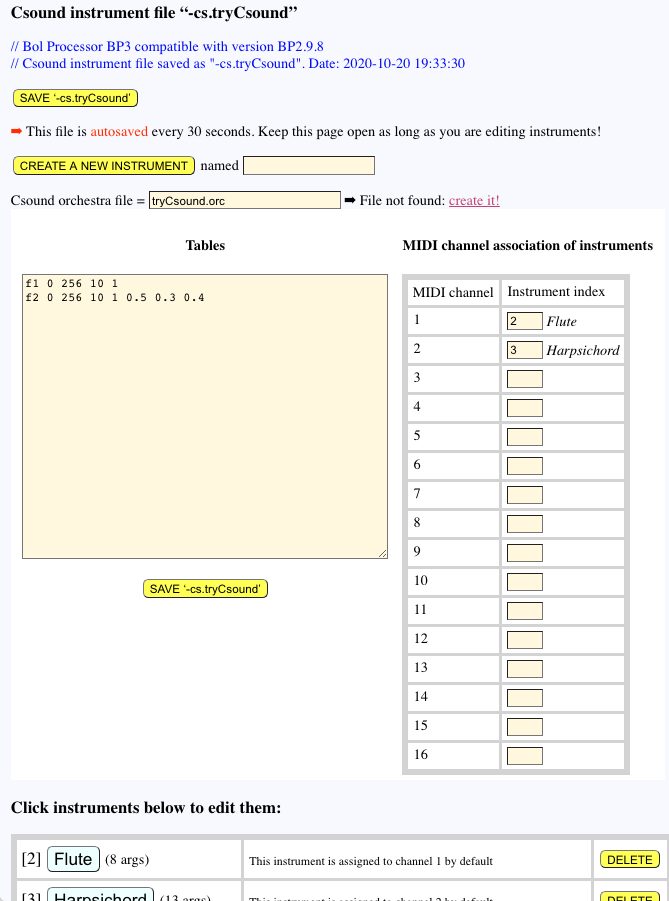
- Open "-cs.tryCsound" in the CSOUND resources folder. This page is in autosave mode (see below): changes to Csound instruments are saved automatically twice per minute.
- This file is linked to a Csound orchestra file called "tryCsound.orc". As this file is missing from the "csound_resources" folder, a link is displayed to create it. Otherwise, the link would open it for editing. The arguments declared in the orchestra must match those in the instrument file.
- The Tables text area contains Csound function tables. They are not used to create the score. They are only copied at the beginning of it.
- Csound instruments can be associated with MIDI channels and to parts of the Bol Processor score. For example, here, MIDI messages sent to channel 2 are converted into notes of instrument 3 "Harpsichord". (The association of parts is recent and not shown on this picture.)
- At the bottom of the page is the list of Csound instruments declared in this file. They can be deleted, restored and duplicated in the same way as sound-object prototypes. Clicking the blue button with the name of an instrument opens its editor.
A simple orchestra file called "0-default.orc" is provided in the "csound_resources" folder. It is used when no other orchestra is specified. See also the Simple Csound orchestra page.
Editing a Csound instrument
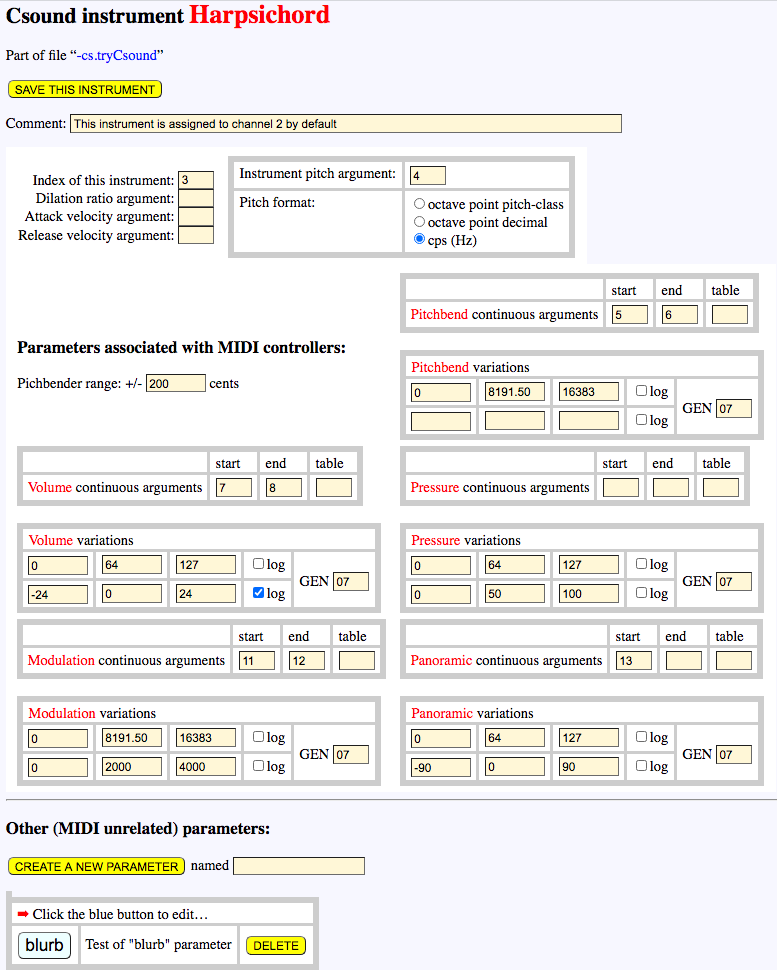
The Csound instrument editor is very similar to the one of BP2.9.8. A detailed description can be found in chapter 17 of the BP2.9.8 reference manual.
- For example, let us look at the instrument Harpsichord in "-cs.tryCsound". Its index is "3", which means that it can be called as _ins(3) or _ins(Harpsichord) in a Bol Processor score.
- The parameters displayed on the "Harpsichord" page are those associated with MIDI controllers. They can change continuously if two arguments are given for their values at the start and at the end of each note. The argument under "table" is the reference of an optional function table.
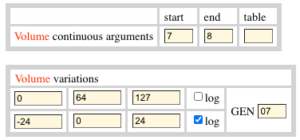
- For the volume parameter, the MIDI values "0", "64" and "127" are converted to the Csound values "-24", "0" and "+24" respectively. This converts a linear scale into a logarithmic scale.
- The start and end values of a continuously changing volume are sent to arguments "7" and "8" respectively. The orchestra uses them to set the volume, with the GEN07 (linear interpolation) or GEN08 (cubic spline) generators.
- Given three pairs of input/output values, the Bol Processor tries to define a quadratic mapping between input and output. It is not always possible to fit the three values to a monotonic quadratic function… See the Csound argument mapping page for a detailed explanation.
- At the bottom of the page is a list of Csound parameters that have nothing to do with MIDI controllers. This is where Csound production by the Bol Processor can differ radically from MIDI!
- This instrument has a single additional parameter called "blurb".
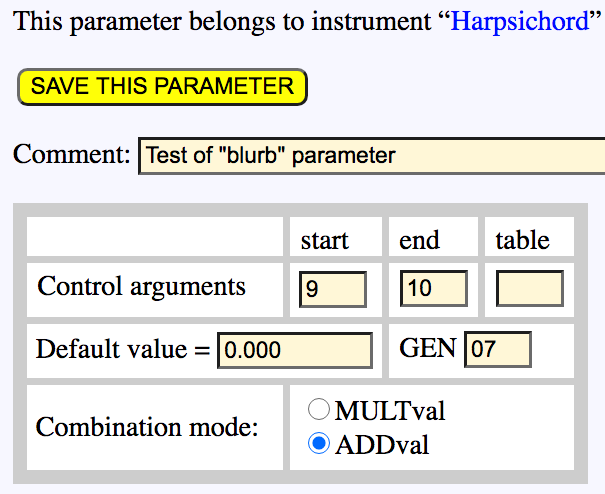
These additional parameters can be created, deleted and restored in the same way as instruments. The interface makes sure that a new parameter does not have the same name as an existing or (temporarily) deleted parameter.
Let us look at the "blurb" parameter (image on the left). Each parameter has a default value, which is not necessarily zero. Values found in Csound scores can be combined additively (ADDval) or multiplicatively (MULTval). The "blurb" parameter sends its start value to argument "9" of the Csound score, and its end value (for continuous variations) to argument "10".
Using a Csound instrument in a grammar

Here is a simple example showing the basic features of Csound in the Bol Processor. A complete demonstration on a real musical example can be found on the Sarasvati vina page. All the features of the Csound implementation are documented on the Csound checkup and Csound objects pages, with examples that you can try yourself.
The Data project "-da.tryCsound" calls "-cs.tryCsound" and uses its instrument "Harpsichord" (number 3). Type the following line in a Data project linked to "-cs.tryCsound" and play it with the Csound score output:
_ins(Harpsichord) _volumecont _volume(127) A4 G4 C5 A5 A4 G4 C5 A5 _volume(0)
The Csound score produced is:
; Csound score
f1 0 256 10 1
f2 0 256 10 1 0.5 0.3 0.4

t 0.000 60
i3 0.000 1.000 440.000 8192.000 8192.000 127.000 111.125 0.000 0.000 0.000 0.000 0.000 ; A4
i3 1.000 1.000 391.995 8192.000 8192.000 111.125 95.250 0.000 0.000 0.000 0.000 0.000 ; G4
i3 2.000 1.000 523.251 8192.000 8192.000 95.250 79.375 0.000 0.000 0.000 0.000 0.000 ; C5
i3 3.000 1.000 880.000 8192.000 8192.000 79.375 63.500 0.000 0.000 0.000 0.000 0.000 ; A5
i3 4.000 1.000 440.000 8192.000 8192.000 63.500 47.625 0.000 0.000 0.000 0.000 0.000 ; A4
i3 5.000 1.000 391.995 8192.000 8192.000 47.625 31.750 0.000 0.000 0.000 0.000 0.000 ; G4
i3 6.000 1.000 523.251 8192.000 8192.000 31.750 15.875 0.000 0.000 0.000 0.000 0.000 ; C5
i3 7.000 1.000 880.000 8192.000 8192.000 15.875 0.000 0.000 0.000 0.000 0.000 0.000 ; A5
;
e 10.000
- Argument "4" is the pitch, here in Hertz (440 for A4).
- Arguments "5" and "6" are the start and end values of the pitchbend, as specified by the instrument. They remain at the default value "8192" in the absence of pitchbend instructions.
- Arguments "7" and "8" are the start and end values of the volume. The volume decreases from 127 to 0 over the eight notes, as expected.
- The _volumecont instruction at the beginning of the sequence means "continuous volume". It resolves a difference between MIDI and Csound: in MIDI, each event happens at a point in time, whereas a Csound note is a segment of time with a duration. It is then up to the orchestra to decide how the parameter changes from the start to the end of each note.
- Arguments "9" and "10" remain at the default value "0" of the unused modulation parameter.
- Arguments "11", "12" and "13" remain at the default value "0" of the unused panoramic parameter.
Csound scores created with "-cs.tryCsound" cannot be played with "0-default.orc", because their arguments do not match.
A real musical example using many features of Csound in the Bol Processor is a phrase of Carnatic music designed by Srikumar K. Subramanian in 1996. Read the description of this example and listen to it (in just intonation):